

Hiring Pipeline Stages: How to Hire Faster in 2026

What are the stages of a hiring pipeline?
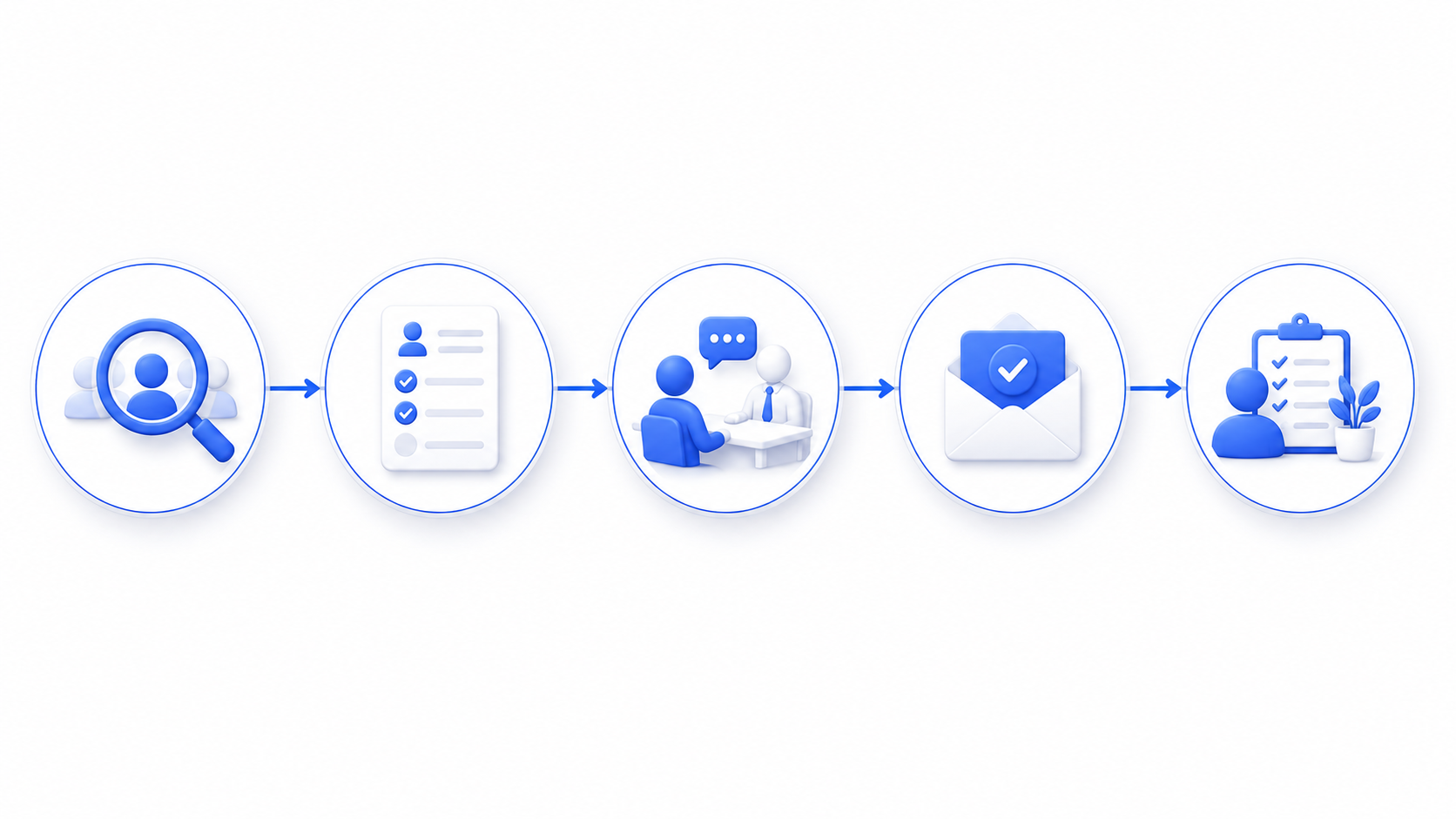
A hiring pipeline has five core stages: sourcing, screening, interviewing, offer, and onboarding. Each stage moves a candidate from "knows your role exists" to "productive employee," and the speed at which you move them through is the single biggest lever on whether you actually land the people you want.
Here is the part most teams in Cairo, Riyadh, and Dubai feel but rarely measure: every week a role sits open is a week you are paying for unfilled work and bleeding your best candidates to faster competitors. The global median time to hire reached 38–41 days in 2025, and senior roles routinely break 90 days. Meanwhile, the strongest candidates are off the market in roughly 10 days. If your pipeline is a chain of spreadsheets, inbox threads, and "I'll get back to you after Eid," you are not competing on talent — you are losing on logistics.
This guide walks each stage, gives you the benchmarks to measure against, and shows exactly where AI removes the bottleneck so you close roles in weeks, not quarters.
The 5 stages of a hiring pipeline, in order
A modern pipeline is a funnel: many candidates enter at sourcing, and a single hire exits at onboarding. Your job is to keep the funnel full at the top and frictionless in the middle. Here is each stage and what "good" looks like.
- Sourcing — attracting and discovering candidates through job boards, your careers page, referrals, and direct outreach. The goal is volume and relevance.
- Screening — filtering applicants down to a qualified shortlist by reviewing CVs against role requirements. This is where manual pipelines leak the most.
- Interviewing — assessing fit and skill through structured conversations, technical tests, and panel rounds.
- Offer — extending, negotiating, and closing the offer before the candidate accepts elsewhere.
- Onboarding — converting a signed offer into a productive, retained employee from day one.
Time-to-hire benchmarks for 2026
You cannot fix what you do not measure. Time to hire counts the days from a candidate entering your pipeline to accepting an offer; time to fill counts from the day you open the requisition. Benchmark yourself against these 2025–2026 figures before you blame "the market."
| Role level | Typical time to hire | What "fast" looks like |
|---|---|---|
| Entry-level | 30–45 days | Under 21 days |
| Mid-level / professional | 31–60 days | Under 30 days |
| Technology / engineering | ~48 days | Under 35 days |
| Senior / leadership | 60–90+ days | Under 60 days |
| Global median (all roles) | 38–41 days | Under 30 days |
One number reframes everything: teams using AI in their pipeline cut time to hire by roughly 26% — an 11-day head start on every role. In a regional market where good engineers and finance talent get multiple offers in the same fortnight, 11 days is the difference between a signed contract and a polite rejection.
Where pipelines leak — and how AI plugs each stage
Most delays are not caused by a shortage of candidates. They are caused by handoffs: a CV sitting unreviewed for four days, an interview that takes a week to schedule, an offer stuck waiting for approval. Below is the bottleneck at every stage and the specific way AI closes it.
| Stage | Goal | The bottleneck | How AI helps |
|---|---|---|---|
| Sourcing | Fill the top of the funnel with relevant candidates | Generic job ads, low-traffic careers pages, slow posting | AI drafts targeted job descriptions and a branded careers page that ranks and converts, so qualified applicants arrive without manual chasing |
| Screening | Produce a qualified shortlist fast | Recruiters reading hundreds of CVs by hand; strong candidates buried | AI CV screening scores every applicant against the role in seconds and surfaces the top matches with reasoning you can trust |
| Interviewing | Assess fit and skill consistently | Scheduling ping-pong, unstructured interviews, scorecards lost in email | Shared pipeline stages, structured scorecards, and automated status moves keep every interviewer aligned and the candidate warm |
| Offer | Close before the candidate accepts elsewhere | Slow internal approvals; manual, error-prone offer letters | Templated offers and a clear approval trail mean you send within hours, not days |
| Onboarding | Make day one productive | Re-keying data, paperwork, payroll set up from scratch | The hired candidate flows straight into employee records and Egyptian payroll — no double entry, no gap |
Stage 1: Sourcing — make candidates come to you
Speed starts before the first application. If you are posting to one job board and waiting, you are sourcing on hard mode. Practical tips to accelerate:
- Run a real careers page. A branded, fast careers page converts passive interest into applications and feeds your pipeline directly — no copy-pasting CVs from email.
- Reactivate your pipeline. Your strongest source of speed is the silver-medal candidates you already interviewed. Tag and re-engage them first.
- Lean on referrals. Referred candidates move through the funnel faster and stay longer — make it one click for staff to refer.
Stage 2: Screening — the biggest time sink, the biggest AI win
Screening is where weeks vanish. A single popular role in Egypt or the GCC can pull 300+ applicants, and a human recruiter realistically reads a fraction of them well. The result: great candidates sit unseen while the clock runs and they accept other offers.
This is the highest-leverage place to deploy AI. AI CV screening reads every application, scores it against the exact requirements of the role, and ranks your shortlist in minutes — turning a four-day backlog into a same-day decision. The recruiter still decides; AI just makes sure no qualified person is buried by volume.
Stage 3: Interviewing — kill the scheduling delay
The interview itself is rarely the problem; coordinating it is. To compress this stage:
- Use structured scorecards so every interviewer rates the same competencies — faster, fairer decisions.
- Batch interviews into a tight window rather than spreading them over weeks.
- Keep candidate status visible to the whole hiring team in one pipeline, so no one waits on an email to know the next step.
Stage 4: Offer — close in hours, not days
You found the right person — now do not lose them to a slow approval chain. The candidate is, by definition, attractive to your competitors too. Pre-agree salary bands and approvers before the role opens, use a templated offer, and aim to send within 24–48 hours of the final interview.
Stage 5: Onboarding — speed that protects retention
A hire is not a win until they are productive and staying. A clean handoff from "offer accepted" to "set up in the system" signals professionalism and cuts early attrition. The killer inefficiency here is re-entering the same data into payroll and HR systems by hand. When recruitment, people records, and Egyptian payroll (income tax and social insurance) live in one workspace, the new hire flows from pipeline to first paycheck without a single re-key.
Run your whole pipeline on one shared record
The Five Hr moves every candidate from sourcing to a compliant Egyptian payslip — AI-assisted, bilingual. On the Free plan, no card.
Start on the Free planHow to build your hiring pipeline in 6 steps
- Define the role precisely. Write must-have vs. nice-to-have criteria — this becomes the scoring rubric for screening.
- Set stage targets. Assign a maximum number of days per stage (e.g., screening in 2 days, first interview within 5).
- Centralize every candidate in one pipeline. No more spreadsheets or inbox threads — one source of truth the whole team sees.
- Automate screening with AI. Let AI rank applicants so recruiters spend their time on the top 10%, not the bottom 90%.
- Measure time to hire per stage. Find your slowest stage and fix it — usually screening or scheduling.
- Connect hiring to onboarding and payroll so a signed offer becomes a live employee instantly.
Why a connected, AI pipeline wins in 2026
HR and recruitment are going AI, fast. Teams still running manual pipelines are not just slower — they are structurally disadvantaged: their best candidates get poached during the very delays a connected system removes. The math is simple. An 11-day AI advantage, applied across every open role for a year, compounds into more hires, lower cost-per-hire, and a stronger team.
The Five HR puts the whole pipeline — AI CV screening, hiring stages, careers pages — in one workspace with people management and Egyptian payroll, so roles close faster and new hires start on day one without re-entry. Built for HR teams, recruiters, and founders across Egypt and the wider Arab and GCC region.
Sources
- 10 Takeaways from the 2025 Recruiting Benchmarks Report — Gem
- What 2025 Time-to-Fill Benchmarks Reveal — Mitratech
- United States Benchmark Recruiting Metrics 2025 — SmartRecruiters
- Technology Benchmark Recruiting Metrics 2025 — SmartRecruiters
Start hiring faster — on the Free plan
Stop letting good candidates leak out of a manual pipeline. Try The Five HR on the Free plan and run your next role on an AI pipeline that closes faster. See the full plans on our pricing page whenever you are ready.

Build a faster, fairer hiring process
Pair this pipeline guide with our ATS explainer and the recruitment toolkit to cut time-to-hire without cutting corners.
Frequently asked questions
What are the 5 stages of a hiring pipeline?
The five stages are sourcing (attracting candidates), screening (filtering to a shortlist), interviewing (assessing fit and skill), offer (closing the candidate), and onboarding (making them productive). Moving candidates quickly through all five is what wins the best talent.
What is a good time to hire in 2026?
The global median is about 38–41 days. Fast teams hire entry-level roles in under 21 days and most professional roles in under 30. Senior roles often take 60–90+ days, so anything under 60 there is strong.
What is the difference between time to hire and time to fill?
Time to hire counts days from a candidate entering your pipeline to accepting an offer. Time to fill counts from the day you open the requisition until a hire accepts, so it includes sourcing time and is usually longer.
How does AI speed up hiring?
AI cuts time to hire by roughly 26% — about 11 days per role — mainly by screening CVs in minutes instead of days, drafting job descriptions and careers pages, and keeping the whole team aligned in one pipeline so candidates never stall.
Where do hiring pipelines leak the most?
Screening and scheduling. A popular role can attract 300+ applicants that no one reviews in time, and interview coordination drags across weeks. AI screening and a shared pipeline remove both bottlenecks.
Does The Five HR handle hiring and payroll together?
Yes. The Five HR combines recruitment (pipelines, AI CV screening, careers pages), people management, and Egyptian payroll in one workspace, so a hired candidate flows straight into employee records and payroll with no double data entry.
Is The Five HR free to try?
Yes — The Five HR has a Free plan. You can sign up at /signup and start running your hiring pipeline on AI right away.
Hire faster, then pay — without re-typing a name
Start on the Free plan with The Five Hr and connect recruitment to compliant Egyptian payroll in one platform.
Start on the Free plan