

What Is an ATS? AI Recruitment in 2026, Explained

An applicant tracking system (ATS) is software that collects job applications in one place and moves each candidate through your hiring stages — from new application to hired — so nothing slips through email and spreadsheets. In 2026, AI is the layer on top: it parses CVs into structured data, summarises and ranks candidates against a role, drafts outreach, and flags duplicates — turning the ATS from a filing cabinet into an assistant that does the busywork while a human still makes every hiring decision.
If you are hiring in Egypt or the wider MENA region, an ATS matters for one extra reason: hiring does not end at "hired." The moment a candidate signs, they become an employee with a tax file, a social-insurance registration and a payslip. The best modern setups carry that one record all the way from first CV to first payslip, instead of re-typing the same person into a separate payroll tool. This guide explains what an ATS is, how the pipeline works, where AI genuinely helps (and where it should not be trusted), how an ATS beats spreadsheets, how to choose one, and why the Egyptian, bilingual, recruitment-to-payroll angle changes what "good" looks like.
Key takeaways
- An ATS centralises applications and moves candidates through defined stages (a pipeline) — replacing scattered inboxes and spreadsheets.
- AI in 2026 is strong at parsing CVs, summarising, ranking, drafting messages and spotting duplicates — but it should assist, not auto-reject; a human owns the decision.
- An ATS beats spreadsheets on collaboration, audit trail, candidate experience, structured search and compliance, not just tidiness.
- Choose on pipeline fit, AI quality, bilingual (Arabic + English) CV parsing, careers-page + Google for Jobs support, data protection, and integrations — use the scorecard below.
- In Egypt/MENA, the real win is a recruitment-to-payroll handoff: one shared record from candidate to payslip, so you never re-key the new hire.
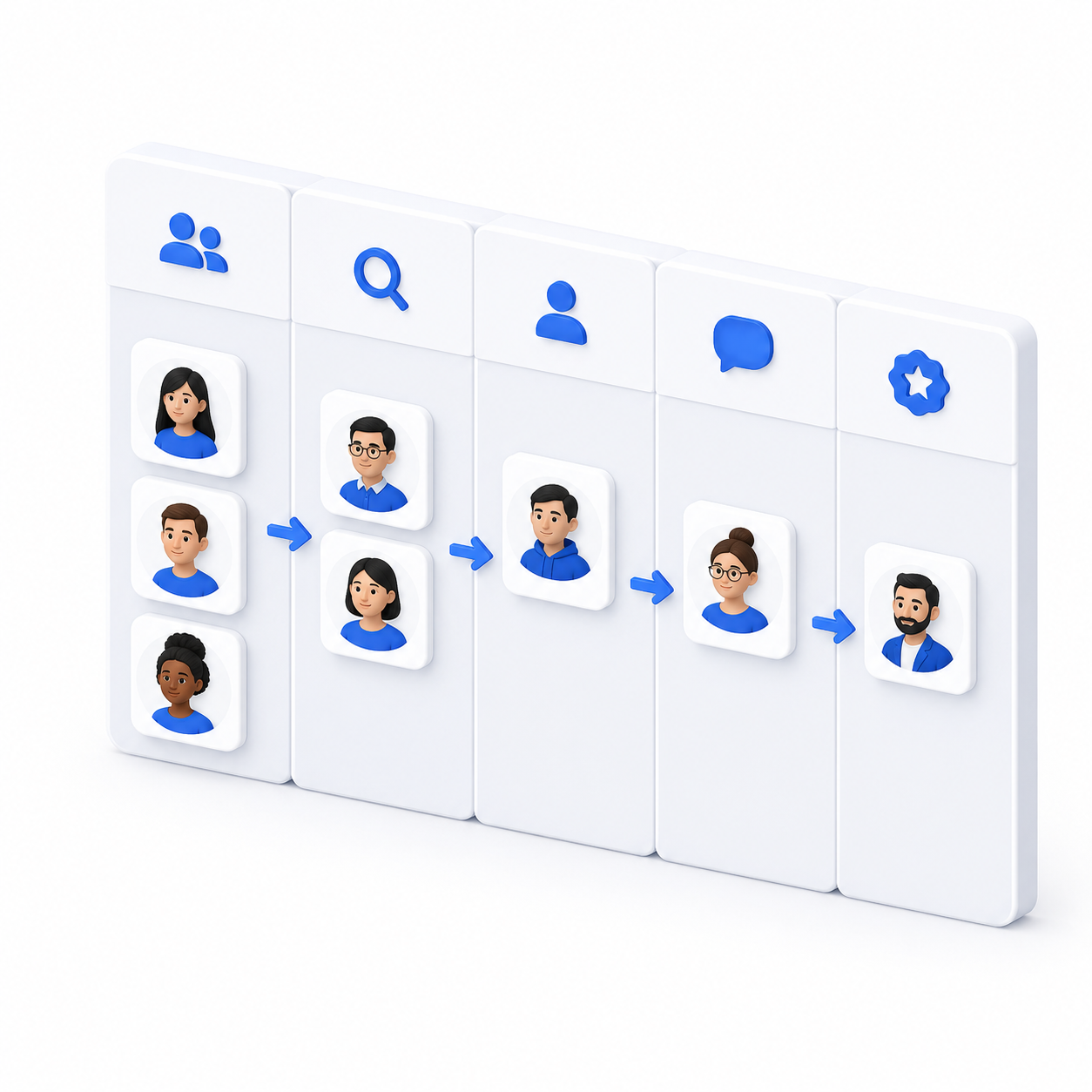
What is an applicant tracking system (ATS)?
An applicant tracking system is the database and workflow tool that recruiters and HR teams use to manage every candidate for every open role in one place. Instead of CVs landing in a shared inbox, a WhatsApp thread and three people's Downloads folders, every application flows into a single record where the whole team can see status, notes, scores and history. At its core an ATS does four jobs: capture applications (from a careers page, job boards, referrals or manual upload), organise them per role, move each candidate through stages, and keep a record of who did what and when.
How does an ATS pipeline work? (the stages)
The "pipeline" is the heart of an ATS — a board where each column is a stage and each candidate is a card you move from left to right. Stages vary by company, but a typical Egyptian SME or agency pipeline looks like this:
- Applied / New — the candidate submits via your careers page or is added manually.
- Screening — a recruiter (often AI-assisted) checks the CV against the must-haves.
- Shortlist — the strongest candidates are flagged for the hiring manager.
- Interview — one or more rounds, with structured scorecards and notes.
- Offer — terms agreed; this is where recruitment quietly becomes payroll.
- Hired — the candidate accepts and converts into an employee record.
- Rejected / Talent pool — politely declined, but kept and searchable for future roles.
Because every candidate sits at a known stage, you get answers spreadsheets can't give quickly: how many people are stuck in screening, how long roles take to fill, and which sources produce hires. That visibility is the quiet superpower of an ATS.
What does AI CV parsing and screening do well — and not well?
AI is what separates a 2026 ATS from a 2016 one. Used properly it removes hours of manual data entry and reading.
What AI does well:
- CV parsing — turning a messy PDF or Word CV into structured fields (name, contact, roles, dates, skills) so candidates become searchable data, not attachments.
- Summarising — a three-line summary of a long CV so a hiring manager grasps a candidate in seconds.
- Ranking and matching — scoring candidates against a job description to suggest a review order (not a verdict).
- Drafting — writing job descriptions, interview questions, outreach and rejection messages for a human to edit and send.
- Deduplication and tagging — spotting the same person who applied twice and auto-tagging skills.
Where AI should not be trusted:
- Auto-rejecting — letting AI silently bin candidates risks unfair, opaque decisions and discarding good people on a keyword miss. Keep a human in the loop.
- Bias — models can inherit bias from historical data. Use AI to surface and summarise, and audit who gets shortlisted. Treat any "score" as a hint, not a fact.
- Hallucinated "insights" — AI can state things about a candidate that aren't in the CV. Always check claims against the source document.
- Sensitive judgement — culture fit, motivation and integrity are human calls.
Rule of thumb for 2026: let AI do the reading and the typing; let a human do the deciding. An ATS that makes this split clear is safer and more defensible than one that hides an opaque "auto-screen."
See recruitment and Egyptian payroll on one shared record
The Five HR carries a candidate from first CV to first payslip — AI-native ATS plus compliant Egyptian payroll, in Arabic and English. On the Free plan, no card required.
Start on the Free plan
ATS vs spreadsheets: what actually changes?
Plenty of teams run hiring on a shared spreadsheet, and for a single role it can almost work. It breaks the moment you have several roles, several people on the hiring team, or any need to look back and explain a decision. The difference isn't tidiness — it's collaboration, memory, candidate experience and compliance.
| Dimension | Spreadsheet | Modern AI-powered ATS |
|---|---|---|
| Where CVs live | Email, chat, folders — easy to lose | Attached to each candidate record, searchable |
| Pipeline visibility | Manual columns, quickly out of date | Live board; every candidate at a known stage |
| CV reading | Open and read each one by hand | AI parses + summarises; you skim structured data |
| Team collaboration | Version conflicts, "who edited this?" | Shared notes, scorecards, roles & permissions |
| Search past applicants | Ctrl+F across files, if you kept them | Filter a talent pool by skill, role, source |
| Candidate experience | Manual, inconsistent replies (or silence) | Branded careers page, templated timely updates |
| Audit trail | None — no record of who decided what | Full history of stage changes and actions |
| Data protection | CVs scattered, hard to control or delete | Central store, access control, easier to honour data requests |
| Reporting | Hand-built, error-prone | Time-to-hire, source & funnel metrics, live |
| Handoff to payroll | Re-type the hire into another tool | Convert the same record into an employee (best-in-class) |
The audit-trail and data-protection rows matter more in Egypt than people expect. CVs are personal data; under Egypt's Personal Data Protection Law, scattering them across inboxes and personal drives is exactly the kind of uncontrolled processing you want to avoid. A central system with role-based access is simply easier to govern.

How do you choose and evaluate an ATS in 2026?
The best ATS is the one your team will actually use every day and that fits how you hire — not the one with the longest feature list. Score candidates (the software kind) against a short set of criteria that map to real work. Below is a practical checklist; the downloadable scorecard turns it into a weighted, point-by-point evaluation you can run across two or three vendors.
What criteria actually matter?
- Pipeline fit — can you define your own stages, run multiple roles, and (for agencies) keep client pipelines separate?
- AI you can trust — does it parse, summarise and rank with a human-in-the-loop, and is it transparent about scores rather than silently auto-rejecting?
- Bilingual reality — can it parse and search Arabic and English CVs, and run a careers page in both? In Egypt this is non-negotiable, and most global tools fail it.
- Careers page + job distribution — a branded, fast careers page that emits Google for Jobs structured data so roles surface in search and AI answers.
- Collaboration & permissions — shared notes, interview scorecards, and role-based access so the right people see the right candidates.
- Data protection — encryption, access controls, an audit trail, and a sensible data-retention/deletion story (Egypt PDPL-aware).
- Integrations & handoff — does it connect to your job boards, email/calendar, and — critically — to payroll so a hire isn't re-keyed?
- Reporting — time-to-hire, source effectiveness and funnel drop-off out of the box.
- Total cost & onboarding — pricing in EGP, a real free trial, and how long until your team is live.
- Support & local fit — does the vendor understand Egyptian/MENA hiring and respond in your timezone and language?
How should you run the evaluation?
Don't judge from a demo alone. Load your own messy CVs — including Arabic ones — and a real job description, then watch the parsing and ranking on your data. Invite one hiring manager and one recruiter to run a single live role end to end during a free trial. Check the careers page on a phone. Ask the vendor to show you, on screen, exactly what data is stored and how you delete a candidate on request. Finally, test the handoff: when you mark someone "hired," what actually happens next?
Why does the Egypt/MENA and bilingual angle change the answer?
Most global ATS platforms were built for English-only, single-country hiring and stop at "hired." In Egypt you need Arabic and English CV parsing, a bilingual careers page, and an understanding that the next step after hiring is a compliant Egyptian payroll — income tax across Egypt's progressive brackets and social insurance under the 2026 rules. A tool that nails recruitment but forces you to re-enter every new hire into a separate payroll system has only solved half the problem.
What is the recruitment-to-payroll handoff, and why does it matter?
The handoff is the moment a candidate becomes an employee — and it's where most stacks leak. With separate tools, someone re-types the new hire's name, ID, salary and start date into payroll, re-uploads their documents, and hopes nothing was mistyped. With one shared record, the candidate you hired in the ATS becomes the employee in payroll: same person, same data, no re-entry, no second source of truth. For Egyptian teams that means the salary you agreed at the offer stage flows straight into tax and social-insurance calculations and a compliant payslip. This single-record idea — "recruitment to payroll, built for Egypt" — is the design principle behind The Five HR, and it's the gap none of the ATS-only or payroll-only tools fully close.
ATS Evaluation Scorecard + AI Recruitment Prompt Pack (PDF)
A weighted, point-by-point scorecard to compare two or three ATS tools on the criteria that matter — pipeline fit, trustworthy AI, bilingual Arabic/English CV parsing, Google for Jobs support, data protection and the payroll handoff. Plus a prompt pack of ready-to-use AI prompts for writing job descriptions, summarising CVs, drafting interview questions and writing fair, friendly candidate updates. Print it, score your shortlist, and decide with evidence instead of a demo.
An ATS in 2026 is no longer a luxury for large enterprises — it's the difference between hiring that's organised, fair and fast, and hiring that lives in inboxes and gets forgotten. Use AI for what it's genuinely good at (reading, summarising, drafting, matching) and keep a human firmly in charge of every decision. When you evaluate tools, score them on pipeline fit, trustworthy AI, bilingual CV parsing, Google for Jobs support, data protection and — the part teams forget — a clean handoff into payroll. In Egypt and MENA, that last point is where one shared record from first CV to first payslip quietly saves whole afternoons every month.
Grab the free scorecard below to run a structured, weighted comparison across the tools on your shortlist, and use the prompt pack to put AI to work on job descriptions, CV summaries and outreach the right way.
Sources
- Google Search Central — Job posting (JobPosting) structured data documentation
- Schema.org — JobPosting vocabulary
- SHRM (Society for Human Resource Management) — talent acquisition guidance
- PwC Worldwide Tax Summaries — Egypt: Taxes on personal income (verify against the latest Egyptian Tax Authority guidance)
- National Organization for Social Insurance (NOSI), Egypt — official social-insurance authority (confirm current rates and wage limits before relying on any figure)
ATS & AI recruitment — frequently asked questions
What is an applicant tracking system in simple terms?
It's software that collects all your job applications in one place and moves each candidate through your hiring stages — applied, screening, interview, offer, hired — so nothing gets lost in email or spreadsheets. Recruiters, hiring managers and HR all see the same up-to-date record.
What's the difference between an ATS and a job board like Wuzzuf or Bayt?
A job board is where you advertise a role and reach candidates; an ATS is where you manage the candidates after they apply. Many teams use both: the job board (or your own careers page) brings applicants in, and the ATS organises, screens and tracks them through to hire.
Can AI screen Arabic CVs?
Yes — modern AI can parse and summarise Arabic as well as English CVs, which is essential for hiring in Egypt. Quality varies by tool, so test it on your own real Arabic CVs during a trial rather than trusting a demo. And keep a human reviewing the results; AI should assist screening, not auto-reject.
Is it safe to let AI reject candidates automatically?
No. Letting AI silently reject candidates risks unfair, opaque and potentially biased decisions, and you can lose good people on a keyword miss. Use AI to parse, summarise and suggest a review order, but keep a human making the actual accept/reject decision and audit who gets shortlisted.
Do small companies and freelancers really need an ATS, or is a spreadsheet enough?
A spreadsheet can survive one simple role, but it breaks down with multiple roles, multiple people on the hiring team, or any need to explain a past decision. Even solo recruiters and small teams benefit from a central record, a searchable talent pool, an audit trail and a branded careers page — and many tools offer free trials so the cost barrier is low.
Why does connecting recruitment to payroll matter in Egypt?
Because hiring doesn't end at 'hired' — the new employee immediately needs a tax file, a social-insurance registration and a payslip. If your ATS and payroll are separate tools, you re-type every new hire and risk errors. One shared record carries the same person from candidate to payslip, with the agreed salary flowing straight into Egypt's income-tax and social-insurance calculations.
Hire, then pay — without re-typing a single name
Start on the Free plan with The Five HR and connect your pipeline to compliant Egyptian payroll in one platform, built for Egypt and bilingual by default.
Start on the Free plan